
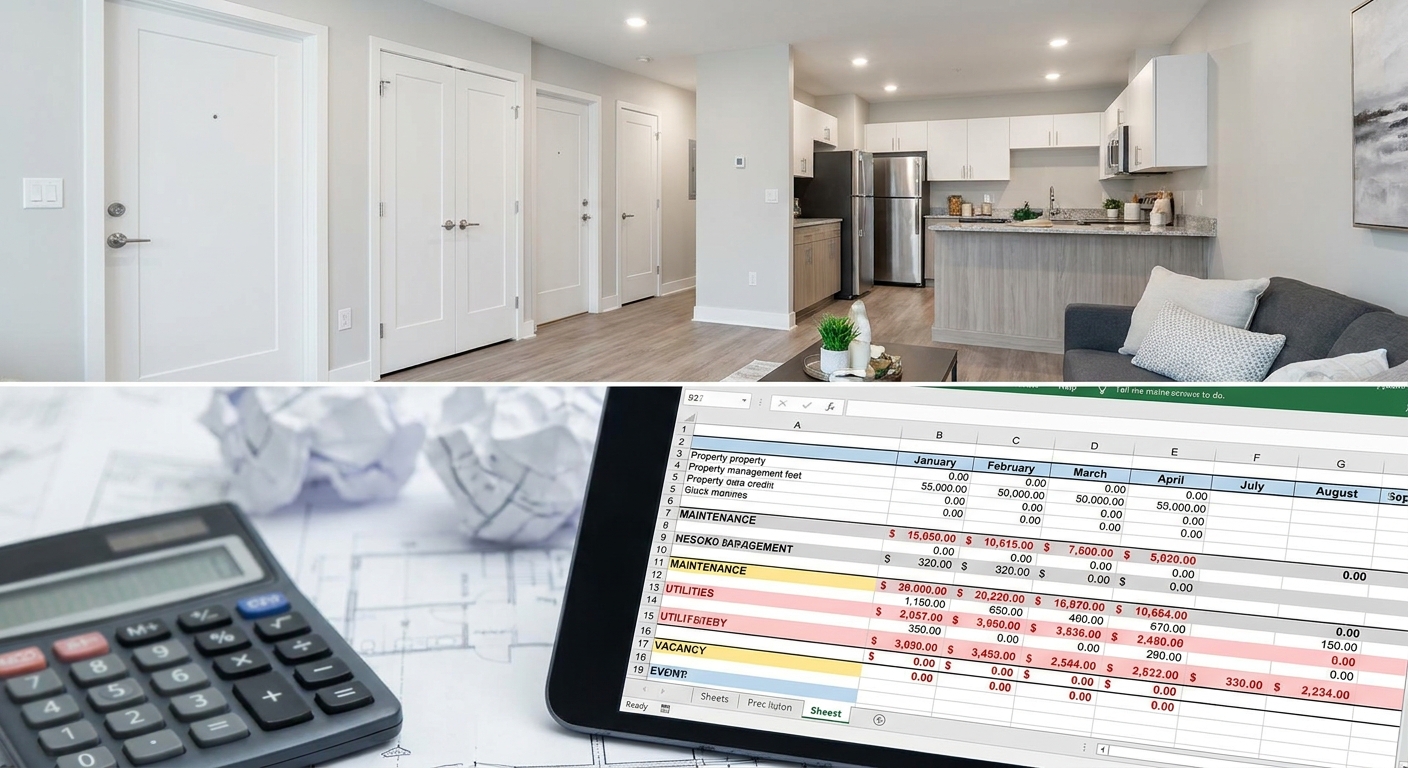
The Co-Living Pitch vs. Central Florida Reality
Co-living platforms, most notably PadSplit, have gained significant traction among real estate investors across Hillsborough, Polk, and Orange counties. The top-line pitch is straightforward: take a standard 4-bedroom, 2-bathroom single-family home that might rent for $2,300 per month on a traditional long-term lease, reconfigure the floor plan to create 6 or 7 private rooms, and rent each room individually for $180 to $220 per week.
On paper, gross monthly collections jump from $2,300 to $5,200 or more. On a property acquired for $320,000 with $35,000 in renovation and conversion costs, a gross revenue bump of that magnitude turns a standard 5.5% gross cap rate into an apparent double-digit cash-on-cash yield.
However, underwriting co-living properties like traditional single-family rentals is a quick way to miscalculate net operating income (NOI). The operational expense structure of a rooming-house model operates closer to hospitality than long-term residential real estate.
The Operational Expenses Nobody Mentions
When evaluating a co-living asset in the Tampa Bay or Orlando metro areas, standard expense assumptions (typically 35% to 40% of gross revenue) do not apply. Real-world operational costs frequently consume 48% to 58% of gross collections.
Here are the specific line items that erode the margin between gross rent and net return:
1. Landlord-Paid Utility Volatility
In a standard long-term rental, the tenant pays electricity, water, and internet. In a PadSplit model, the host covers all utilities. In Central Florida, cooling costs between May and October are substantial. Six occupants running continuous air conditioning, taking individual showers, and running daily laundry cycles routinely generate utility bills between $550 and $800 per month for a 2,000-square-foot home.2. Platform and Processing Fees
PadSplit charges a platform fee (typically 12% of collected revenue) to manage marketing, payment processing, and member screening. While this replaces traditional property management software costs, it remains a fixed top-line deduction that must be factored into your pro-forma before calculating NOI.3. Accelerated Capital Expenditure and Maintenance
Six adult residents sharing common spaces drive significantly higher wear and tear than a single family. Common area furniture replacement, wall scuff repair, plumbing line clears, and appliance servicing occur at 3x to 4x the frequency of a standard rental home. Budgeting $150 to $200 per room annually for cap ex reserves is necessary to maintain asset condition.4. Turn Costs and Room Turnover
The average length of stay in a co-living arrangement ranges from 6 to 9 months. With 6 individual rooms, you may experience 8 to 10 room turns per year per property. Each turn requires a deep clean of the bedroom, lock reset or reprogram, mattress protection replacement, and minor touch-up paint—costing between $150 and $300 per turn.5. Specialized Insurance Premiums
Standard landlord insurance policies (DP-3) generally exclude rooming houses or properties with more than three or four unrelated occupants. Securing a commercial or specialized residential co-living policy in Florida often adds a 25% to 40% premium increase over a standard dwelling policy.Underwriting Comparison: Standard LTR vs. PadSplit
To see how these costs impact bottom-line returns, consider a practical underwriting comparison for a Central Florida property purchased for $330,000 with a $250,000 debt load (6.5% interest rate, $1,580/month principal and interest):
Standard Single-Family Rental
- Gross Rent: $2,300/month ($27,600/year)
- Operating Expenses (Taxes, Insurance, Repairs, Vacancy at 38%): $10,488/year
- Net Operating Income (NOI): $17,112/year
- Debt Service: $18,960/year
- Net Annual Cash Flow: -$1,848 (Negative cash flow; relies on appreciation)
PadSplit Co-Living Model (6 Rooms)
- Gross Rent ($200/week/room average at 92% occupancy): $5,750/month ($69,000/year)
- Platform Fees (12%): $8,280/year
- Utilities (Power, Water, Trash, Internet): $7,800/year
- Taxes & Specialized Insurance: $7,200/year
- Maintenance, Turns & Cap Ex Reserves: $6,500/year
- Total Operating Expenses: $29,780/year (43.1% of gross revenue)
- Net Operating Income (NOI): $39,220/year
- Debt Service: $18,960/year
- Net Annual Cash Flow: $20,260/year
Even after accounting for elevated operational overhead, the net cash flow outperforms traditional long-term rentals significantly. However, the initial underwriting must reflect the true $29,780 expense load rather than an arbitrary 30% rule of thumb.
Municipal Zoning and Regulatory Risk
Beyond operational expenses, capital allocators must review local land-use regulations. Municipalities across Pinellas, Hillsborough, and Orange counties hold varying definitions regarding maximum unrelated occupants in single-family residential zones (often capped at 3 or 4 unrelated individuals unless registered or zoned appropriately).
Deploying capital into co-living strategies in Central Florida requires targeting unincorporated county pockets or municipalities with clear guidelines regarding rooming houses. At ANEW Collective, having underwritten and navigated hundreds of transactions across Tampa Bay and Central Florida, we help investors evaluate zoning compliance alongside real-world net yield before capital is committed.